SURF
- Surfing
Basic
How to Guide and Fundamentals of Surfing
Paddle
Out
Learning
how to paddle a surfboard from the shore out to the
"lineup", the place beyond the breaking waves where
surfers wait to catch waves, is one of the hardest and
most frustrating of things to acomplish in surfing.
You must learn a few things to do this.
Learn Perfect Form 1.
Adjust your weight forward or backward until you feel
the board staying the most level in the water. When
you're in the "sweet spot", paddling produces the
greatest speed. To paddle, alternate your arms like
a swimming stroke. Lift your head and neck, arching
your back slightly to get maximum leverage and angle.
2. If you're lying too far back on the surfboard,
the nose lifts up too much and it's difficult to get
decent paddling speed. 3. Lying too far forward will
cause the nose to dig into the water, decreasing paddling
efficiency and speed.
Rules of the road Don't paddle out
where the waves are peaking. Surfers will be running
you down. Paddle in on either side of the breaking
waves. The person riding the wave has the right-of-way.
Paddle into the soup rather than into the path of
a surfer. When two or more surfers head in the same
direction on a wave, the surfer closest to the peak
has priority. Don't crowd surfers. If there are only
a few surfers, be considerate and surf a little way
down the beach. If you can't go anywhere else, as
a beginner you should ride the soup or leftovers.
Turtling: You can
also "turtle" the board, that is, grab it by the rails
and flip it over so the fins are on top.
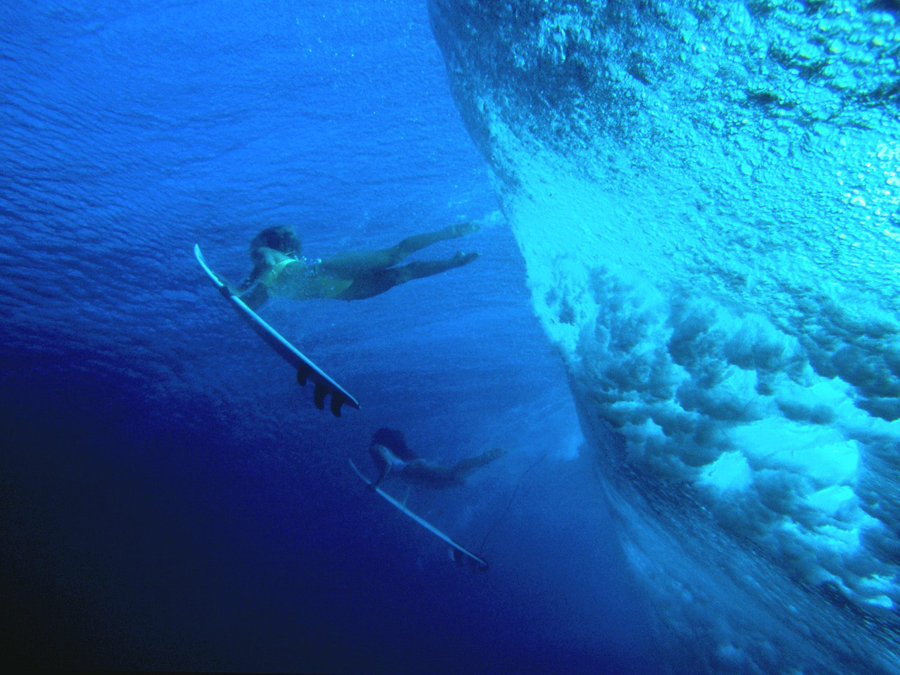
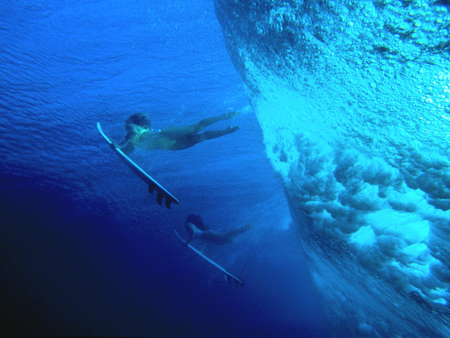
Duck diving: If you're on a shorter board, the preferred
technique of wave avoidance is called duck diving.
1. Push the nose of the board under the water, using
your knee, arms and body as leverage.
2. When you are fully submerged, keep pressure on
the tail of the board. When the wave passes over you,
pull the board back to the surface and through the
back of the wave, using you free leg as a ancor and
your board as a bobber.
The best conditions for learning to surf are when
the sun is out, the water is at least 65 degrees and
the waves are not too large. Find a beach that's not
swarming with other surfers.
Tips for getting outside:
It's often frustrating for beginners as they attempt
to paddle through the white water and breaking waves.
More often than not, the waves slap beginners around
like a washing machine. Try to avoid being hit by
a wave while the board is perpendicular or sideways
to the wave.
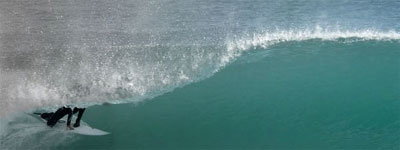
Please Never "Drop-In"
Front of Anyone Not Only It's Rude It is also Unsafe!
Dropping in on someone is when you
get in the way of the surfer on the main "peak"
of the wave. If a surfer is coming towards you, and
you are on the "shoulder", you can ruin a
wave for both you and the surfer, and is very dangerous
and costly. This happens all the time, but mostly on
accident. One simple thing to prevent this is to look
for the surfers around you.
A great
surfing experience is when you are able to ride at least
One really "killer" wave, Two really "Great"
waves and three or more "OK" waves with in
a 90 minute time period with no conflicts or injuries
Waves tend to show every minute but
good one show up every five minutes and twenty to forty
five minutes for the the better ones; so it can be hard
to share the good waves that you can enjoy.
If you are a beginner you should
consider a few things before paddling out.
Is there a lot of surfers out?
You should learn as far away as possible from others.
How are the conditions, and the surroundings?
Pay attention to rip-tides and other Hazards.
Is there a lifeguard nearby?
It is highly recommend to learn as close to a lifeguard
Tower as possible

Do It with Responsibility &
Respect
Surfing
California - Google
Maps
View
Larger Map
|